Named as you play it
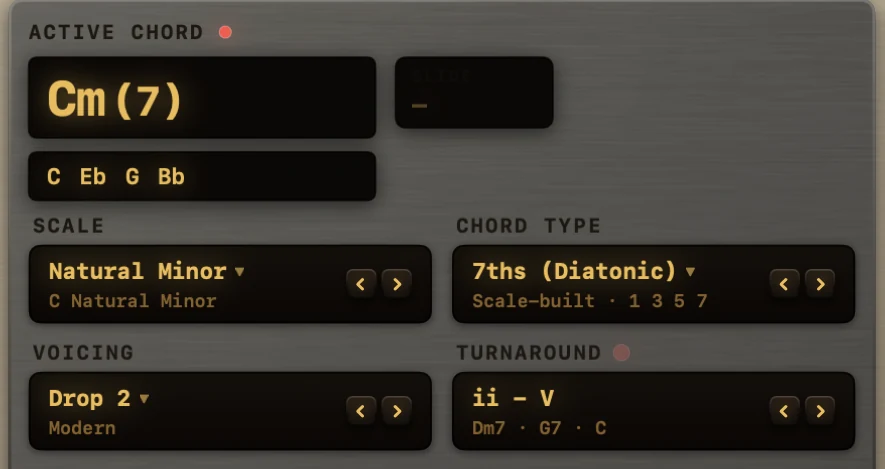
The active chord, its notes, the scale it came from, the voicing it is wearing and the turnaround waiting on Control. Nothing is hidden behind a menu, and hovering anything on the console says what it does.
Chord instrument for macOS
A laptop key becomes a real chord, voiced the way a pianist would voice it, sent straight to your DAW.
ACm7 / C Eb G Bb
Press A, S, D, F,G, H, or J, or tap the keys. These are the app's own chords in C natural minor, 7ths, drop 2. The same seven the console above is holding.
Web Audio, in this page. The app itself sends MIDI, and plays its own piano if you switch that on.
Fmaj9 with the third on top. A ii V I that actually voice leads. The idea takes a second. Drawing it into a piano roll takes twenty minutes, and by then the idea has gone.
Pick a key and a scale. The seven pads under your fingers become that scale's chords, named as you play them, every one a single keystroke away.
The active chord, its notes, the scale it came from, the voicing it is wearing and the turnaround waiting on Control. Nothing is hidden behind a menu, and hovering anything on the console says what it does.
Everything that shapes the chord, tabbed in a single window.
Key, velocity, hold, single note, glide, strum and the walking bass, all one click from where you are playing. No page to open first.

Switch these on and the same seven keys start playing figures a hand would play, not blocks a grid would print.
Harmonik broadcasts itself as a virtual MIDI source the moment it opens. No plugin, no wrapper, no host to crash.
Harmonik MIDI appears as a source straight away. Nothing to configure, no clock or BPM to match.
Most DAWs listen to every active MIDI input, so a record-armed track just plays. If yours doesn't, set its input to Harmonik MIDI.
Your computer keyboard, a USB or Bluetooth controller, or the pads on screen. Record it like anything else you play in.

Works with
And anything else that accepts a virtual MIDI input. It plays a built in piano too, if you would rather not open a DAW at all.
One time purchase
$100once
Lifetime updates. No subscription.
Currently in beta, and ad hoc signed rather than notarized, so macOS asks you to confirm the first launch. Both change before release. More in the questions below.
It is a MIDI instrument first: it plays whatever synth or sampler you point it at. There is also a built in piano using macOS's own sound bank, off by default, for playing without opening a DAW.
No. It is a standalone macOS application. It broadcasts itself as a virtual MIDI source called Harmonik MIDI as soon as it opens, so there is no plugin to install, no wrapper, and no host that can take it down with it.
The letter keys on your computer keyboard, any USB or Bluetooth MIDI controller, or the chord pads on screen. The space bar works as a sustain pedal, and a real pedal on your keyboard works at the same time. Press ⌘K for the full key map.
Expected on the current build. Harmonik is ad hoc signed rather than notarized, so the first launch needs one confirmation: Control-click the app, choose Open, then Open again. If that option is not offered, go to System Settings, Privacy & Security, and choose Open Anyway.
This changes when the app is signed with a paid Apple Developer ID and notarized, before release.
The instrument is complete and played daily. It is called beta because it has not been through a signed, notarized public release yet, and because the changelog is still moving quickly. You get every update after that at no extra cost.
Not yet. A Windows port is in development and is not available to buy. Join the list and you will hear when it lands.
The macOS application and every future update to it, once, with no subscription. That is the whole commercial arrangement as it stands today. Anything else, such as a seat count or a refund window, is not settled yet, so it is not claimed here.